

 Retirement Lifestyle Advocates


Weekly Update from RLA Tax and Wealth Advisory
By: Dennis Tubbergen
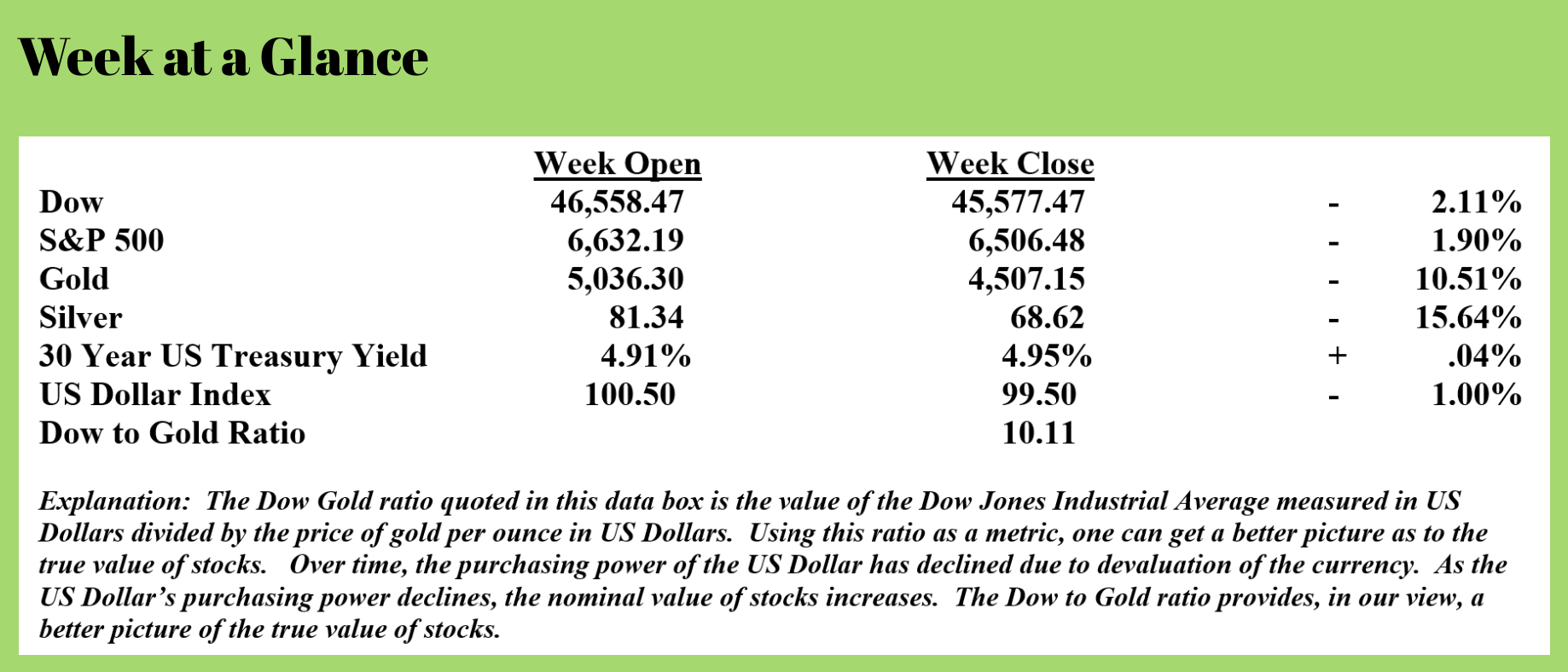
Metals Fall Hard
As if on cue, after I suggested I am long-term bullish on metals, both gold and silver fell hard.
Despite the decline, the fundamentals have not changed. There are still potential problems with the silver Comex inventories, and the recent inflation report shows inflation heating up once again. And that’s before the rocketing oil prices have taken their toll on other consumer items considered when calculating the inflation rate.
Despite the decline, both gold and silver remain in a long-term uptrend. Long-term investors might talk to a financial professional about adding to positions here in my view.
National Debt Hits $39 Trillion
US Treasury debt hit $39 trillion last week, increasing by $1 trillion in five months and $2 trillion in 7 ½ months (Source: https://wolfstreet.com/2026/03/19/bond-market-gets-edgy-as-us-treasury-debt-hits-39-trillion-spiking-by-2-trillion-in-7-5-months-and-not-slowing-down/).
Since the debt ceiling was raised in July, the national debt has increased by $2.8 trillion. Bond investors are getting nervous as the interest rate on the 30-year US Treasury is once again closing in on 5%.
The yield on all US Government debt maturities is increasing despite the Fed’s accommodative monetary policy since September of 2024. In other words, as the Fed has cut, interest rates have increased.
The reason is simple; lenders charge borrowers an interest rate that is commensurate with the risk the investor is taking by making the loan. The Fed held interest rates steady at their recent meeting, given that inflation is heating up.
No matter what the Fed policy might be when May arrives with a new Fed Chair, look for interest rates to increase over the long-term.
The Super Bowl Top Signal
Chris MacIntosh, writing for “International Man,” made an interesting observation that he refers to as “The Super Bowl Top” signal.
MacIntosh cites the calendar year 2000 Super Bowl that he dubbed “The Dot-Com Bowl”. During that Super Bowl, 14 internet start-ups bought advertising during the Super Bowl including Pets.com. That company shelled out $1.2 million for the now infamous sock puppet commercial to tell the audience about the company’s business. Ten months later, the company was no more. The stock went from $11 per share at the time of the Super Bowl to zero.
Eight of the dot.com companies that advertised during the Super Bowl were either bankrupt or had their stocks selling for pennies on the dollar within one year of advertising.
The Super Bowl's top advertising theory was proven right once again in 2020. MacIntosh calls the 2020 Super Bowl “The Crypto Bowl”. FTX, Coinbase, Crypto.com, and eToro spent $54 million collectively on Super Bowl advertising. Nine months after those monster advertising expenditures, FTX was bankrupt, and Coinbase shares had fallen 70%. The 2021 Super Bowl had zero ads for Crypto.
The 2026 Super Bowl could be called the Artificial Intelligence Super Bowl. 16 tech companies bought Super Bowl ads, including OpenAI, Google, Amazon, Meta, Anthropic, Genspark, Base 44, Rippling, and Ramp, to name some of the advertisers. So does that mean the AI top is in?
There is certainly an argument to be made that it is. For starters, the broad market rally over the past couple of years hasn’t been broad at all. It has been driven by AI companies. Now, with the Dow very close to a 10% decline from the peak and the S&P 500 down more than 7% from the peak, the stock market is looking suspect.
There is also some crazy stuff happening or being considered that is characteristic of market tops. Alphabet (Google) is looking to issue a 100-year bond (reference MacIntosh’s article). The last time this happened was in 1997 as the tech stock bubble was building. The company was Motorola. At the beginning of the calendar year 1997, Motorola was a top-25 market cap and top-25 revenue company. It was all downhill from there, as they say, for Motorola.
Motorola is now the 232nd largest market cap company with annual sales of $11 billion.
Big tech is spending $700 billion on AI this year. As MacIntosh notes, Amazon is going into debt, Google’s free cash flow is down 90%, and the companies are paying influencers up to $600,000 each to convince you to use AI.
As I’ve stated many times in this publication, AI reminds me of the dot-com bubble. The technologies have value, as dot.com has proven, but that doesn’t mean that AI is not in a huge bubble. From my perspective, it is, and the correction is not an ‘if’ question, rather a ‘when’ question.
Just look at a couple of recent earning reports.
Amazon had the largest capital expense in its history of $200 billion. The company’s stock is down 9%, and its free cash flow declined by 71%.
Google had $185 billion in spend. Its stock was down 5%, and its cash flow fell from $73 billion to $8 billion.
Meanwhile, Amazon filed with the SEC about needing to raise debt to keep building.
My advice?
Be cautious and use the Revenue Sourcing planning strategy to take at least some of this market risk off the table.
RLA Radio
The RLA radio program this week features an interview that I conducted with New York Times best-selling author Neil Howe.
Neil co-authored the books “Generations” and “The Fourth Turning” many years ago. “The Fourth Turning” was prophetic, accurately predicting more than two decades ago where we are economically and politically presently.
I talk to Neil about his latest book, “The Fourth Turning is Here”. It’s a fascinating conversation that I’d encourage you to check out. The interview is now posted. You can listen now by clicking on the "Podcast" tab at the top of this page or by visiting your favorite podcast channel.
Quote
“Time is the coin of your life. It is the only coin you have, and only you can determine how it will be spent. Be careful lest you let other people spend it for you.”
-Carl Sandburg

Comments