

 Retirement Lifestyle Advocates

 Weekly Update from RLA Tax and Wealth Advisory
By: Dennis Tubbergen
Big Banks Changing Their Tune on Gold
After the big decline in the metals markets about one month ago, seems that some of the big banks are now getting on board with recommending precious metals to their clients.
One big bank, which at one time was fined for manipulating the price of precious metals, has now recommended to its clients that instead of investing in a 60/40 portfolio, which is 60% in stocks and 40% in bonds, investors now consider a 60/20/20 portfolio with 60% in stocks, 20% in bonds, and 20% in gold. (Source: https://vongreyerz.gold/even-banks-now-bow-to-a-golden-master)
And some big banks are now adjusting their 2026 year-end price targets for gold. Goldman Sachs just made the bank’s revised 2026 year-end price target for gold, stating that the bank expects gold to reach $5,400 per ounce by year's end. The bank added that there was ‘significant upside risk,’ which means that they think prices could move even higher.
JP Morgan was even more bullish on the yellow metal, stating that $6,300 per ounce was the bank’s base case for gold prices with an upside high of as much as $8,500 per ounce. (Same source as above)
As I stated here last week, I believe that these price targets are not only entirely possible but highly likely. While I refrain from forecasting prices, the fundamentals favor higher prices for precious metals. Here are three (there are more) reasons that I believe gold and silver will move higher (probably much higher) by year's end.
One, market dynamics have not changed. Central banks remain large buyers of gold, and industrial demand for silver significantly exceeds mining output. In short, demand for both gold and silver remains strong.
Two, excessive debt levels on the balance sheet of the federal government will have to lead to the Federal Reserve eventually becoming the buyer of last resort for US Government debt. That will mean even more quantitative easing, which will lead to more consumer price inflation.
Three, COMEX market inventories are declining. Increasingly, precious metals futures traders are standing for delivery of the metal. Simply put, more traders are opting to take the metals rather than the paper profits. The rate at which these traders are standing for delivery is simply unsustainable. COMEX inventories are down 75% from 2020. In the case of silver, inventories have fallen to 85 million ounces. For perspective, in December, more than 45 million ounces of silver were physically delivered on the COMEX.
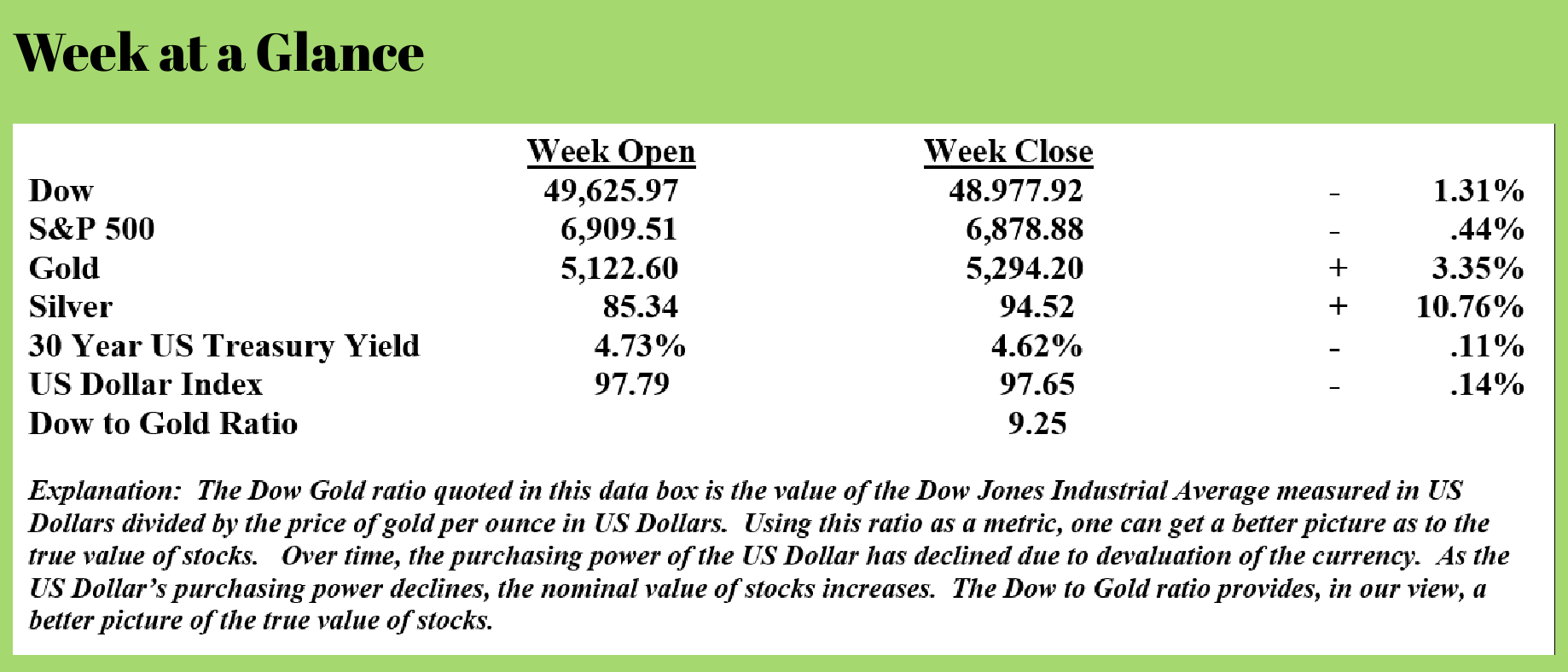
Incidentally, silver has moved from $78.14 per ounce two weeks ago to $94.52 to close last week. That’s an upward move of about 21% in just ten trading days.
Dimon on Markets
Jamie Dimon, CEO of JPMorgan Chase, recently suggested that the current market environment looks a lot like 2007, shortly before markets totally collapsed. (Source: https://www.moneymetals.com/news/2026/02/24/jpmorgan-ceo-this-looks-a-lot-like-the-run-up-to-2008-004716)
Dimon put it this way, “My own view is that people are getting a little comfortable that this is real, these high asset prices and high volumes, and we won’t have any difficulty whatsoever.”
But then Dimon warned that this cycle will eventually turn, “There will be a cycle one day…..I don’t know what confluence of assets will cause that cycle. My anxiety is high over it. I am not assuaged by the fact that asset prices are high. In fact, I think that adds to the risk.”
Dimon noted that he is concerned about the growing level of debt and the loosening lending standards of many banks, “Unfortunately, we did see this in ’05, ’06, and ’07, almost the same thing. The rising tide lifting all boats, everyone was making a lot of money, people leveraging to the hilt. The sky was the limit. I see a couple of people doing some dumb things. They’re just doing dumb things to create net interest income.”
With debt continuing to rise and the Fed once again engaging in QE, Dimon is right to be anxious. There is plenty to worry about.
CBO Report Has Social Security Unable to Pay Full Benefits by 2032
The Congressional Budget Office just issued its annual report sand in it, reports that the Social Security program will be unable to pay full benefits by 2032. That’s now less than 6 years away!
Last year’s report had 2033 as the year full benefits would no longer be able to be paid; this year’s report moved that up one year due to higher cost-of-living adjustments and lower tax revenues. (Source: https://www.cbo.gov/publication/62105#_idTextAnchor228)
It’s no secret that the Social Security system needs major reform. Given that in about six years, the long-forecast problem of an insolvent Social Security system becomes a reality, the days of the collective group of politicians in Washington kicking the proverbial can down the road are about to come to an end.
While there have been no specific proposals put forth to attempt to ‘fix’ the Social Security program, one proposal to right the sinking Social Security ship has been suggested by the American Institute for Economic Research. That proposal is to transition the Social Security program to a flat benefit program. (Source: https://thedailyeconomy.org/article/defusing-the-social-security-time-bomb/)
A flat-benefit program would have all Social Security recipients receive the same benefits, maybe 125% or 150% of the federal poverty level, regardless of the recipient’s earning history or the level of Social Security taxes paid.
While I would be opposed to this as a solution, I think it’s reasonable to assume that the Social Security program will be ‘fixed’ on the backs of productive Americans. Let me also be clear – this solution has at this point only been discussed by analysts, and I am not aware of this being seriously considered as a solution, at least presently. That said, I think that higher taxes are coming simply because this problem cannot be solved without more money. The very best thing to do now to protect yourself is to do everything that you can to legally reduce your taxes.
RLA Radio
The RLA radio program this week features an interview that I conducted with Dr. Jonathan Newman of the Mises Institute. The interview is posted and available on any podcast distribution platform, as well as on YouTube.
Quote of the Week
“Never attribute to malice what can be adequately explained through stupidity.” -Unknown

Comments